
Last Updated on October 14, 2026
AI Transparency VerifiedCan you really earn money by helping train AI? That’s the question behind this micro1 review. Over the past year, AI training work has become one of the most talked about ways to earn online, and micro1 is one of the biggest platforms offering it. However, the headlines rarely tell you what the process is actually like, or who gets hired.
Tip: Create your free account through this link now, even if you apply later. That way your profile is ready the moment a role that fits you opens.
In this micro1 review, I’ll walk you through how micro1 works, step by step. You’ll learn how the AI interview works, how pay works, which roles exist, and the honest downsides most reviews skip. By the end, you’ll know whether it’s worth your time.
Disclosure: some links in this post are referral links. If you apply through one, get hired, and complete your first paid hours, I receive a bonus from micro1. It costs you nothing, and I only recommend platforms I’ve researched carefully.
What Is micro1?
micro1 is a US company that describes itself as an AI data lab. In simple terms, it connects people who have real world knowledge with companies building AI systems.
Here’s why that matters. AI models learn from examples. To improve, they need humans who can check their answers, correct mistakes, and add expert judgment. That’s where you come in.
For example, a doctor might review medical answers written by an AI. Similarly, a native French speaker might correct French transcriptions produced by a machine. Meanwhile, a finance professional might evaluate how well an AI explains a financial concept.
The company also appears to be well funded. According to independent reviews, micro1 raised a $35 million Series A at a $500 million valuation in September 2025. Funding doesn’t guarantee a good experience, of course. Still, it’s a sign the company isn’t a short lived side project..
How Does micro1 Work?
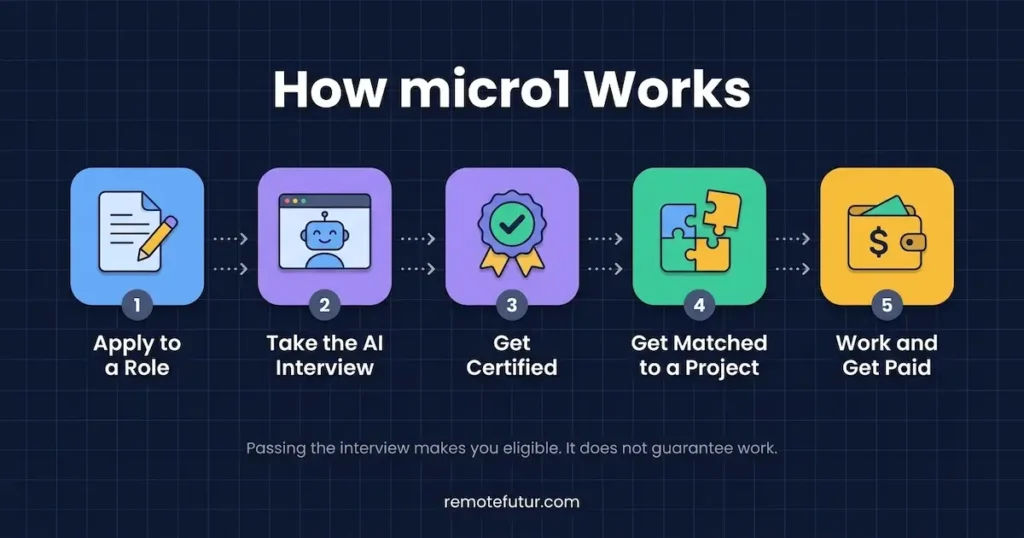
Before we dive into the steps, here’s the big picture. The process has five main stages:
- You apply to a role on the opportunities page.
- Next, you complete an AI interview with micro1’s AI interviewer, called Zara.
- If you pass, you become certified for that skill.
- After that, micro1 matches you to a client project when one fits your profile.
- Finally, you do the work and get paid.
One detail is easy to miss. Passing the interview does not mean you start working right away. It makes you eligible for projects, and projects depend on what clients need at the time. We’ll come back to this, because it’s the most important thing to understand before you apply.
micro1 Review: How Much Can You Really Earn?
This is the question every micro1 review needs to answer, so let’s be clear and honest.
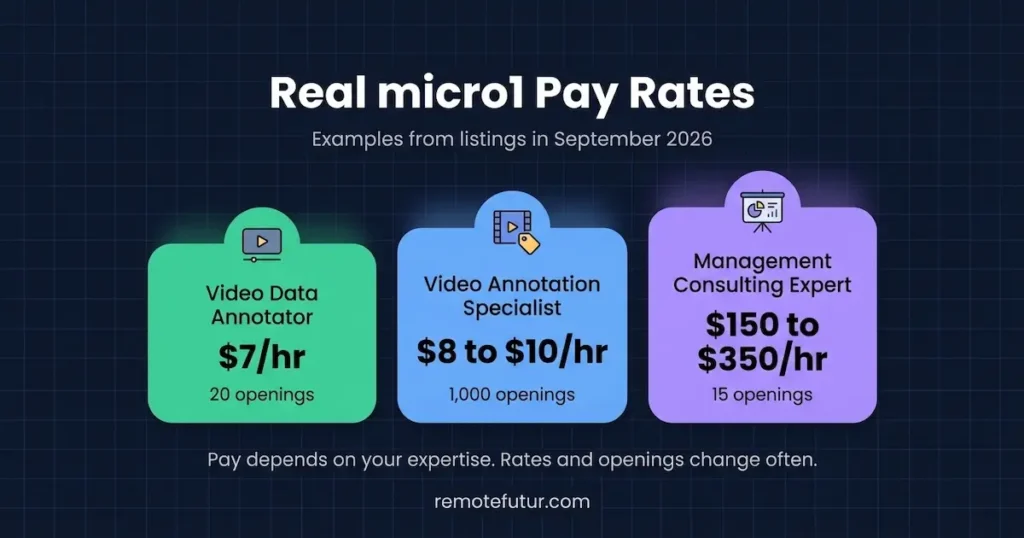
Pay depends entirely on the role, and the range is wide. Each job listing shows its own pay. When I checked the listings in September 2026, here’s what I found:
- A Video Data Annotator role paid $7 per hour, with 20 openings.
- A Video Annotation Specialist role paid $8 to $10 per hour, with 1,000 openings.
- A Management Consulting Expert role paid $150 to $350 per hour, with just 15 openings.
Notice the pattern here. General annotation roles have more openings but lower pay. In contrast, specialist roles pay far more, but there are fewer spots and the bar to get in is much higher. For example, the consulting role prefers at least two years of client facing experience at a major management consulting firm.
Even the lower paid roles aren’t always beginner friendly, though. The $7 per hour annotation role, for instance, prefers previous experience with video annotation, and it strongly favors people who have worked with robotics footage. So read every listing carefully before you apply.
You may also spot a few senior leadership roles with very large annual salaries. Those are rare, full time executive positions rather than typical AI training work, so they aren’t a realistic benchmark for most people reading this.
In other words, your earning potential depends mostly on your expertise. The more specialized and in demand your skill, the higher the rate you’ll see.
Tip: No role that fits you yet? Create your free account now anyway, so you can apply as soon as one opens.
How micro1 Pays You
As for how you get paid, independent reviewers report that micro1 signs contractors through Deel and pays in US dollars twice a month. Deel is a well known global payroll platform used by many remote companies. Before you apply, check that Deel supports withdrawals in your country.
There are also a few realities to keep in mind:
- You work as an independent contractor, not an employee. Reviews note that either side can end the agreement with five business days of notice.
- Work is project based. When a client project ends, your hours may stop until you’re matched to a new one.
- There are no benefits such as paid leave or health insurance.
In short, micro1 can be a good source of extra income. However, it’s not a stable salary, and you shouldn’t treat it like one. The real risk isn’t unpaid work. Instead, it’s the idle time between projects.
How to Earn Money Training AI on micro1: Step by Step
Now let’s walk through the full process, from checking eligibility to getting paid.
Step 1: Check That You’re Eligible
First of all, make sure micro1 can work with people in your country. micro1’s official terms don’t publish a full list. Instead, they state that people located in countries under comprehensive economic sanctions can’t take part.
However, independent reviewers have reported a longer list of 20 countries and regions where micro1 cannot hire: Afghanistan, Belarus, China, Cuba, the Democratic Republic of the Congo, Hong Kong, Iran, Iraq, Libya, Macao, Myanmar, North Korea, Russia, Somalia, South Sudan, Sudan, Syria, Venezuela, Ukraine, and Yemen.
Because this list isn’t official and can change, the safest step is to email support@micro1.ai before you invest time in preparation. It’s better to know now than after an hour of interview practice.
Step 2: micro1 review – Choose the Right Role
Next, browse the open roles. At the time of writing, micro1 groups its work into areas such as:
- Health
- Legal
- Finance
- Languages
- Tech
- Trade based work
- Robotics
- General roles
Pick roles that match your real background. This is the single biggest factor in whether you pass. The interview checks your actual knowledge, so applying for a role you can’t back up usually wastes your time.
Not every role requires a degree, though. Some work is open to generalists. For instance, micro1 has recruited large numbers of people to review and label robot videos, and other projects have asked generalists to record everyday interactions with objects in their homes for robotics training.
Tip: You don’t have to take the interview straight away. Create your free account now, then use the checklist below to prepare before you start.
Step 3: micro1 review – Read the Job Description Carefully
Once you find a role, read the full listing before you click apply. Specifically, look for:
- The required skills
- The preferred qualifications
- Any language requirements
- The pay
Pay close attention to wording like “native level fluency” or “professional experience.” These are real filters. If a role asks for native French and your French is good but not native, you’ll likely struggle in the interview.
Step 4: micro1 review – Prepare for the AI Interview
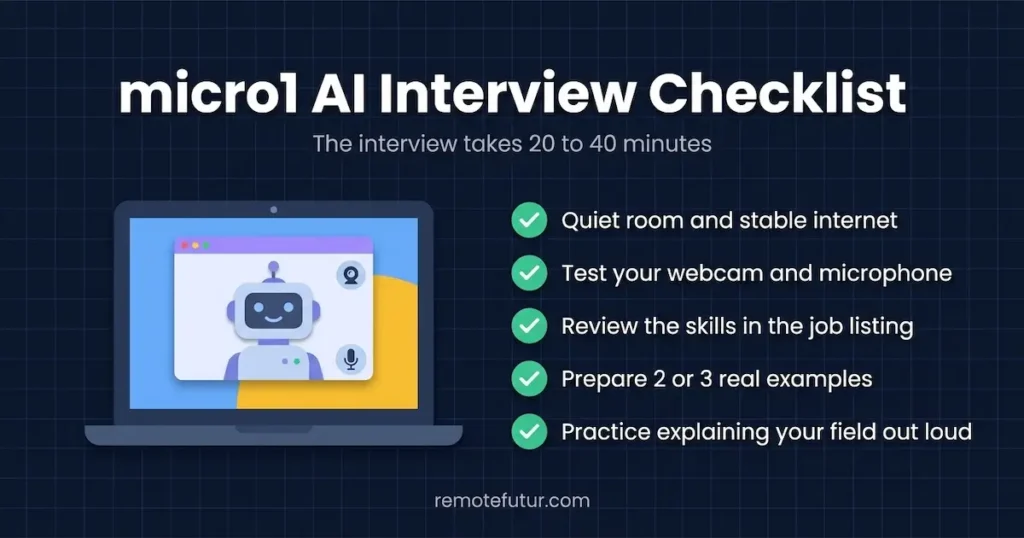
Preparation makes a real difference here. micro1 has an official interview prep page, and it’s worth reading before you start.
Every applicant goes through a skill based interview with Zara, micro1’s AI interviewer. According to micro1’s own FAQ, the interview takes 20 to 40 minutes depending on the role, and some roles add a short skills assessment afterward.
To prepare well:
- Find a quiet room with a reliable internet connection.
- Test your webcam and microphone beforehand.
- Review the key skills listed in the job description.
- Prepare two or three real examples from your experience that you can explain clearly.
- Practice speaking about your field out loud, since explaining things simply is part of the job.
Step 5: Take the Interview
When you’re ready, start the interview. Take your time with each answer. Rather than trying to sound impressive, aim to be clear, specific, and honest.
For example, if you’re asked how you’d check an AI’s answer for errors, walk through your actual process. Say what you’d look for first, what sources you’d trust, and how you’d explain the correction. Concrete steps show real expertise far better than general claims.
Step 6: Get Certified and Wait to Be Matched
If you pass, you become certified for that skill. From here, your profile is eligible for matching projects.
This is where patience matters. Matching depends on client demand, so micro1 matches some people quickly while others wait. Meanwhile, you can apply to other roles that fit your skills. That way, you give yourself more chances to land a project sooner.
Step 7: Do the Work and Get Paid
Once you’re matched, you’ll receive project instructions. Follow them closely, since quality matters a lot in AI training. Clients rely on accurate, consistent work, and micro1 is more likely to pick careful contributors again.
After that, micro1 pays you on its regular schedule through the payment setup you choose.
A Real Example: What a micro1 Role Looks Like
To make this concrete, let’s look at a real listing I reviewed on micro1: a French Language Expert role.
This role is a remote contractor position. Its main tasks include:
- Reviewing and correcting French transcriptions produced by machines
- Adding metadata tags and detailed annotations to transcripts
- Analyzing audio to catch dialects and errors that automated tools miss
- Giving clear feedback to help improve the process
The listing asks for native level fluency in French, professional level English, strong attention to detail, and experience with transcription. Experience in linguistic review or localization is a strong plus.
What does this tell us? First, roles are specific. Second, they reward real skills you may already have. Finally, the work is detailed and sometimes repetitive, so it suits people who enjoy precision.
micro1 Review: Pros and Cons
Every platform has strengths and weaknesses, and no honest micro1 review should skip either side. Here’s a balanced look at both.
Pros
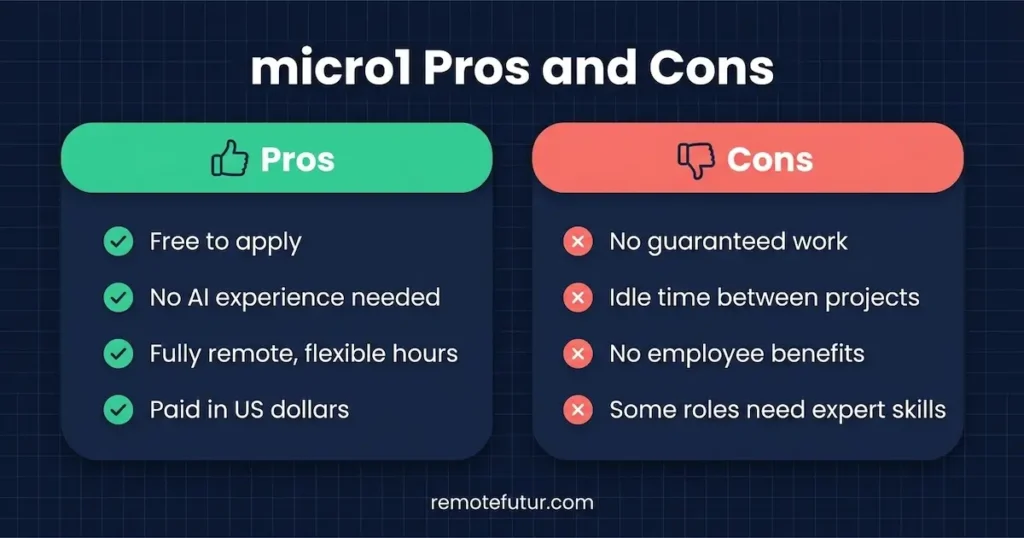
- It’s free to apply. You never pay to join or take the interview.
- Most roles don’t require prior AI experience. Your existing expertise is what counts.
- The work is fully remote with flexible hours.
- There’s a wide range of domains, from languages and law to robotics.
- Pay is in US dollars through a known payroll platform.
- The AI interview is fast compared to traditional hiring.
Cons
- Passing the interview doesn’t guarantee work. Idle time between projects is common.
- Projects can end with short notice.
- There are no employee benefits, since you work as a contractor.
- Some roles ask for native level skills or professional experience, which rules many people out.
- The work can be repetitive, which some people find tiring.
- People in some countries can’t apply at all.
It’s also worth reading reviews with care. Independent analysis has found that most of micro1’s thousands of Trustpilot reviews describe the AI interview rather than paid work, and that micro1 invites candidates to leave them. For a more candid picture, check the official micro1 subreddit as well.
micro1 Review: Who Is It Best For?
micro1 is a good fit if you:
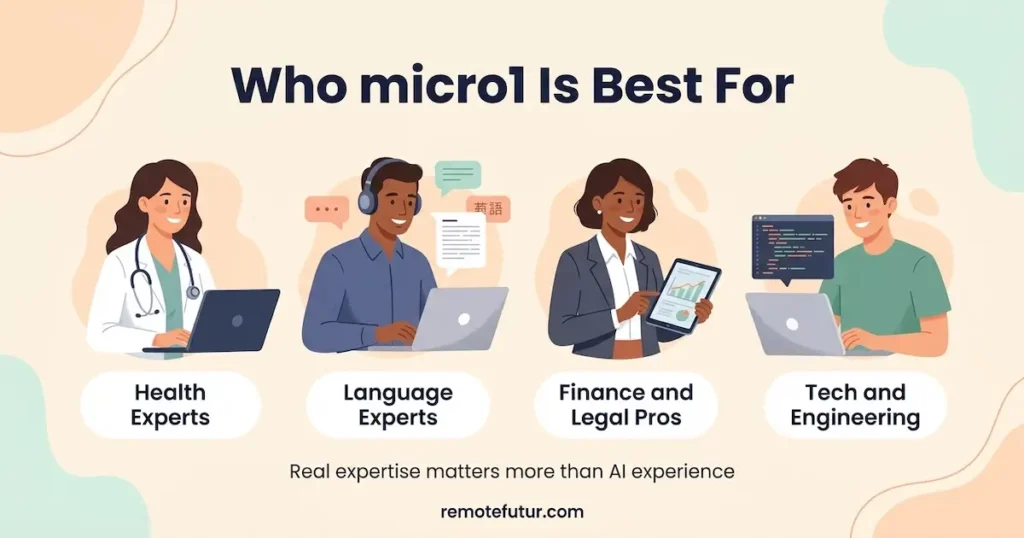
- Have real expertise in a specific field, such as medicine, law, finance, engineering, or a language
- Want flexible, remote side income
- Enjoy detailed, careful work
- Can handle irregular hours without financial stress
- Already have another income source
On the other hand, micro1 may not suit you if you:
- Need a stable, full time salary right away
- Dislike repetitive tasks
- Don’t have a strong skill to offer yet
- Live in one of the restricted countries
If you want more stable remote roles, take a look at my list of the 10 best remote job boards. You might also like my guide to the Remotive job platform or my Remote Rocketship review.
Roles change often, so it’s worth checking back every week or two.
My Honest micro1 Review So Far
I want to be transparent about where I stand. So far, I’ve explored micro1’s opportunities page in detail, compared several job listings across different fields, and read through the official FAQ and interview prep guide.
A few things stood out. First, the job descriptions are clear about what each role involves and who it’s for. Second, requirements vary a lot, from general roles open to beginners to specialist roles that ask for native language skills or professional experience.
I haven’t taken the AI interview myself yet. However, I plan to apply soon and share the full experience in a follow up post, including the role I chose, how the interview went, and whether I got matched to paid work. Until then, I’ll keep this micro1 review updated as listings and policies change.
Tips to Improve Your Chances
Based on everything I’ve learned, these tips can help:
- Apply only to roles that match your strongest skills.
- Read the interview prep guide before you start.
- Apply to more than one relevant role to reduce waiting time.
- Keep your answers specific and honest during the interview.
- Treat micro1 as one income source among several.
Likewise, if you’re building a freelance career alongside AI training work, my SolidGigs review covers another way to find paid projects.
micro1 Review: The Final Verdict
So, is micro1 worth it? For the right person, yes.
micro1 offers a real, legitimate way to earn money by applying your skills to AI training. It’s free to join, the interview is quick, and the range of roles is wide. However, it’s not a steady job. Work comes in projects, waiting time is real, and the best roles go to people with genuine expertise.
If you have a strong skill and want flexible side income, it’s well worth applying. If you need guaranteed income right now, combine it with more stable options.
micro1 Review FAQs
Is micro1 legit?
Yes. micro1 is a registered US company with significant funding, and independent reviewers report that micro1 pays contractors through Deel. Still, results vary, and getting certified doesn’t guarantee paid work.
How long does the micro1 AI interview take?
According to micro1, the AI interview takes 20 to 40 minutes. Some roles also require a short skills assessment afterward.
Do I need AI experience to work on micro1?
No. Most listings say you don’t need prior AI experience. Your knowledge in your field is what matters most.
How does micro1 pay?
Independent reviews say micro1 pays contractors in US dollars through Deel, twice a month. Check that Deel supports your country before applying.
Can I work on micro1 from anywhere?
micro1 works with people in most countries, but people in sanctioned countries can’t take part, and independent reviews report a list of 20 excluded countries and regions. micro1 doesn’t publish an official list, so contact its support team to confirm before you apply.
Is micro1 a full time job?
Usually not. Most work is contract based and depends on client projects, so hours can change from month to month.
Does it cost anything to join micro1?
No. Applying and taking the AI interview are both free.
Conclusion
To sum up this micro1 review, AI training is a real opportunity, and micro1 is one of the most accessible places to start. Go in with clear expectations, apply for roles that match your skills, and prepare well for the interview. Above all, treat it as flexible extra income rather than a replacement for a stable job.
If you’re ready to try, take a look at the roles that are open right now.

Questions before you apply? Message us on the Remote Future Facebook page and I’ll do my best to help.
Want more ways to build your remote income? Explore my guide to what UGC is and how to make money with it, or check out the best AI tools for content creators in 2026.
Work Smarter. Live Better.
Affiliate Disclosure: This post contains affiliate and referral links. So, if you click through, apply, and get hired, we may earn a referral bonus at no extra cost to you.
Related Reads
Ibra A. is the founder of Remote Future, a site covering AI tools, remote work, and online business strategies. He holds a Facebook Social Media Marketing certificate from Coursera and actively tests AI tools to support independent creators and small business owners. His focus is practical, no-hype guidance for people building lean online businesses.
Content on Remote Future is created using AI tools to support efficient research and writing for remote workers and creators, followed by human edits for clarity and accuracy.
Read our AI Editorial Policy.